How Tall Does a Pool Fence Have to Be?
By Mae Fence Company
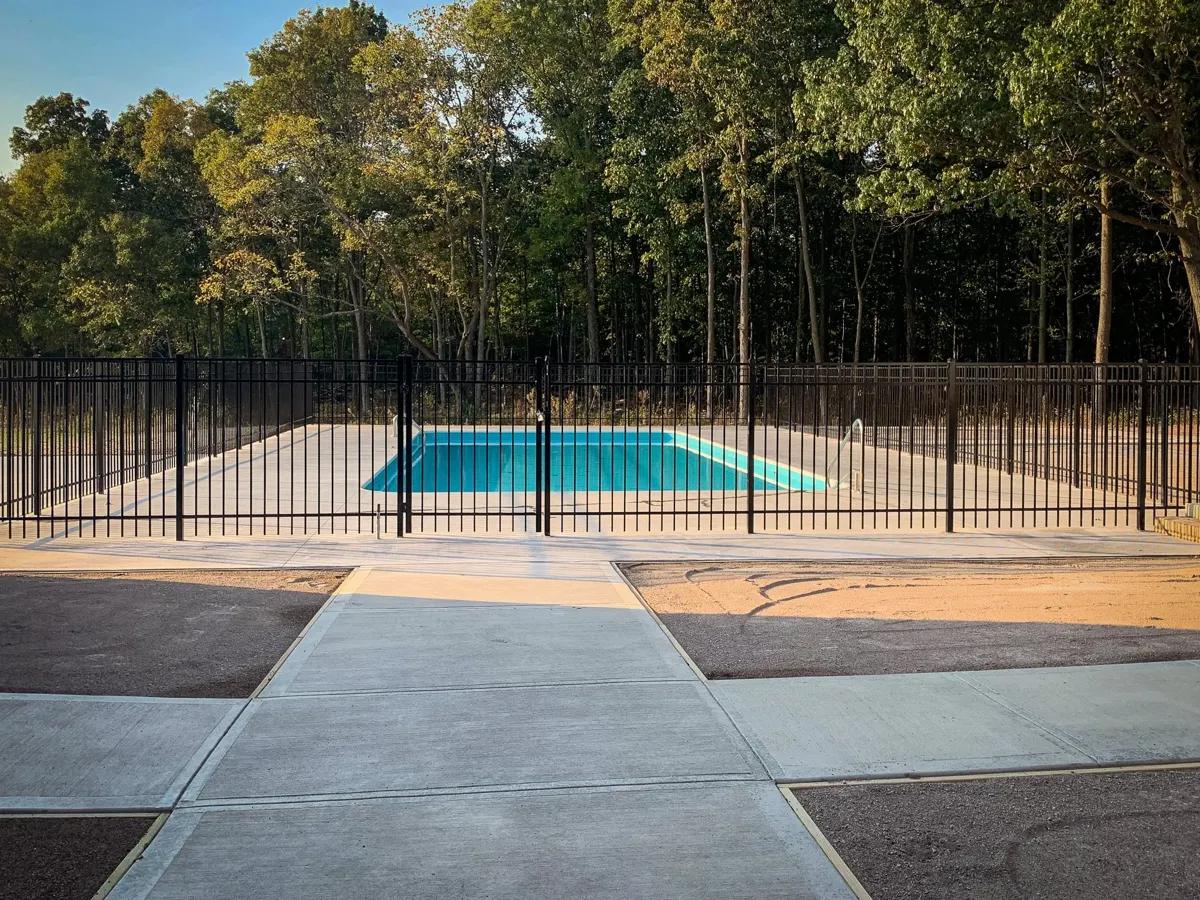
Under the International Swimming Pool and Spa Code (ISPSC), the top of a pool or spa barrier must be at least 48 inches above grade, measured on the side of the barrier that faces away from the pool or spa, and that height must exist around the entire perimeter [2]. Some states, counties or municipalities require pool barriers of 60 inches, the CPSC notes, so the code your town has adopted decides [3].
What is a pool barrier supposed to stop?
The Consumer Product Safety Commission’s guidelines say a successful pool barrier keeps a child from getting over, under or through it, and away from the pool unless supervising adults are present [3]. A young child can get over a barrier that is too low or one that has handholds or footholds to climb [3]. A child can be kept from getting through a barrier by restricting the size of openings and by using self-closing, self-latching gates [3]. The guidelines also say to place a barrier where permanent structures, equipment or similar objects cannot be used to climb it [3]. Pool barrier rules regulate height, gaps and footholds together because each one closes a different way past the fence. Barriers are not child proof, the CPSC adds, but they give a child layers of protection when adult supervision lapses [3].
Where is the height measured, and what changes the number?
The ISPSC requires outdoor pools and spas, and indoor swimming pools, to be surrounded by a barrier that meets its Section 305, and these are the rules that section sets [1].
| What the code covers | The rule | Source |
|---|---|---|
| Height and where it is measured | The 48-inch height keeps smaller children from simply hopping the fence, and it is measured on the outside of the barrier | ISPSC commentary [2] |
| Gap at the bottom, grass or gravel | No more than 2 inches between grade and the bottom of the barrier, measured on the side away from the pool | ISPSC [2] |
| Gap at the bottom, concrete or another solid surface | No more than 4 inches between the solid surface and the bottom of the barrier, measured on the side away from the pool | ISPSC [2] |
| Openings | No opening may let a 4-inch sphere pass through | ISPSC [1] |
| Closely spaced rails | Where the tops of the rails are less than 45 inches apart, the rails must be on the pool or spa side, and the space between pickets, and within decorative cutouts, may not exceed 1¾ inches | ISPSC [1] |
| Widely spaced rails | Where the tops of the rails are 45 inches or more apart, spacing between pickets may be up to 4 inches | ISPSC [1] |
| Above-ground pool wall | The pool wall can serve as the barrier only if its bottom is on grade, its top is at least 48 inches above grade around the whole pool, the wall meets Section 305.2, and the manufacturer allows the wall to serve as a barrier | ISPSC [1] |
| House wall as one side | Where doors, gates or windows in that wall give direct access to the pool, one of these is required: an alarm listed and labeled as a water hazard entrance alarm in accordance with UL 2017, a safety cover listed and labeled in accordance with ASTM F1346, or an approved means of protection, such as self-closing doors with self-latching devices | ISPSC [1] |
The ISPSC is a model code: it sets a baseline, and the version your town has adopted, with any changes it made, is the one that governs.
What does the gate need to pass?
Under the ISPSC, doors and gates in a pool barrier must be equipped to take a locking device, and pedestrian access gates must open outward, away from the pool [1]. The CPSC’s guidelines add that pedestrian access gates should be self-closing and have a self-latching device [3]. If a properly designed gate is not completely latched, a young child pushing on it to get into the pool area will at least close it and may engage the latch, according to the CPSC [3].
Under the ISPSC, at residential pools and spas, a latch release that is reached from outside the barrier and is not self-locking must be at least 54 inches above the finished floor or ground [1]. The CPSC’s guidelines say that where the latch release is less than 54 inches from the bottom of the gate, it should be on the pool side of the gate at least 3 inches below the top [3]. Where the release is on the inside of the barrier, the ISPSC says openings in the gate and barrier within 18 inches of the latch can be no greater than ½ inch in any dimension [1]. On double gates, the ISPSC requires at least one leaf to be secured in place and the other to have a self-latching device [1].
Our four-foot aluminum pool fence panels are built to the 48-inch line many Ohio communities ask for, and taller panels are available if your municipality wants more. Our aluminum pool gates hang on self-closing hinges with a self-latching, lockable latch, set to swing the way the code requires and with the latch at the height it asks for. On our aluminum pool fence, picket spacing and rail placement are chosen to pass, and a puppy picket or tight-spaced panel closes the gaps further. The puppy picket aluminum style adds narrow spacing along roughly the bottom 22 inches and keeps standard spacing above. Pool barrier rules vary from town to town, so the specialist reviews what applies to your address, and when we install the fence, our permitting department handles the permit and assists with HOA approval. For the walk gate types and sizes we build, see our gates and entries page.
Who sets the rule for your pool?
The Residential Code of Ohio for One-, Two-, and Three-Family Dwellings governs the construction, alteration, use and location of those homes [4]. Its section on swimming pools, spas and hot tubs is listed as deleted [5]. Its scope section says the code does not prevent a local governing authority from adopting additional regulations for residential structures, if the regulations comply with that section [4].
Two cities show how a local code words the rule. Columbus requires a building permit for the installation, repair, maintenance or location of any swimming or wading pool that can hold more than 24 inches of water [7]. Columbus has a 48-inch-high barrier requirement, and it exempts a pool at least 48 inches high with a removable ladder or a barrier around the ladder [7]. Strongsville requires all pools to comply with its zoning code and the 2018 ISPSC as adopted [8].
The Ohio Department of Health’s pool rules define a public swimming pool and a private residential swimming pool separately [6]. A public swimming pool is one intended to be used collectively for swimming, diving or bathing [6]. A private residential swimming pool is one located at a dwelling housing no more than three families and used exclusively by the residents and their non-paying guests, and the rules say a public swimming pool does not mean a private residential swimming pool [6].
The CPSC’s guidelines are not a CPSC standard or mandatory requirements, and they tell readers to check with their local authorities [3]. For the permit side of a fence project, see our guide to Ohio fence permit requirements. The yard limits that still apply to the rest of the fence line are in our guide to fence height limits in Ohio yards, and more Ohio fence rules are in our fence guides.
Frequently asked questions
Does a hot tub or spa need the same barrier as a pool?
The CPSC’s guidelines say the definition of pool includes spas and hot tubs, so the barrier guidelines apply to them as well as to above-ground pools, and may include larger portable pools [3]. The ISPSC exempts from its barrier sections a spa or hot tub equipped with a lockable safety cover complying with ASTM F1346, and a swimming pool equipped with a powered safety cover complying with ASTM F1346 [1]. A manually installed, nonpowered pool cover does not provide relief from the barrier requirement, according to the ISPSC commentary [1].
Can my house wall count as one side of the pool fence?
It can, but the CPSC’s guidelines say a fence completely surrounding the pool is better than one with the house as the fourth side, and that where the home is one side, door alarms go on all doors leading to the pool area [3]. In homes not required to be accessible units, the ISPSC puts an alarm’s deactivation switch at least 54 inches above the finished floor [1]. In Columbus, where a dwelling wall forms part of the barrier and a door gives direct access to the pool, the door must either have an alarm whose deactivating touch pad is mounted at least 54 inches above the floor, or open away from the pool area and be self-closing with a self-latching device whose release is a minimum 54 inches above the floor [7].
Does an above-ground pool need a separate fence?
The CPSC’s guidelines say above-ground pools should have barriers, with the pool structure itself serving as one or a barrier mounted on top of the pool structure [3]. Where the pool wall serves as the barrier, the ISPSC asks that ladders or steps be capable of being secured, locked or removed, except where a barrier surrounds them [1]. In Strongsville, any part of an above-ground pool that measures less than 48 inches from the top rail to grade requires a barrier [8]. For more on above-ground pools, read our guide to whether an above-ground pool needs a fence.
Can a pool fence have horizontal rails on the outside?
Yes, when the tops of the rails are 45 inches or more apart: the ISPSC commentary says spacing that wide poses a climbing difficulty for children, so those rails could be on either side of the fence [1]. The CPSC bases its 1¾-inch limit on picket gaps on the foot width of a young child, to reduce the potential for a foothold [3].
Can a privacy fence along the property line serve as the pool barrier?
Under the ISPSC, a solid barrier with no openings may not contain indentations or protrusions that form handholds and footholds, apart from normal construction tolerances and tooled masonry joints [1]. The ISPSC also requires the top of the barrier to be at least 48 inches above grade for 3 feet out from the outside of the barrier, a point to check where the fence sits on the property line [2].
Sources
- International Swimming Pool and Spa Code, Section 305, Barrier Requirements. International Code Council. Copy published by York County: https://www.yorkcounty.gov/DocumentCenter/View/69087/item-9c---ISPSC-305
- 2021 International Swimming Pool and Spa Code and Commentary, Section 305.2.1, Barrier height and clearances. International Code Council. Copy published by the Town of Thompson’s Station: https://www.thompsons-station.gov/sites/default/files/uploads/documents/Community%20Development/Building-Codes/Building%20Permit/pool-barrier-height-and-clearances-ispsc-chapter_3.pdf
- Safety Barrier Guidelines for Residential Pools, Publication 362. U.S. Consumer Product Safety Commission: https://www.cpsc.gov/s3fs-public/362%20Safety%20Barrier%20Guidelines%20for%20Pools.pdf
- Ohio Administrative Code 4101:8-1-01, Residential Code of Ohio, Scope and Administration. Ohio Board of Building Standards: https://codes.ohio.gov/assets/laws/administrative-code/rules/4101/8/4101$8-1-01_eff_7_1_19.pdf (also at the Legal Information Institute: https://www.law.cornell.edu/regulations/ohio/Ohio-Admin-Code-4101-8-1-01)
- Ohio Administrative Code 4101:8-3-01, Building Planning (Residential Code of Ohio). Ohio Board of Building Standards: https://codes.ohio.gov/assets/laws/administrative-code/rules/4101/8/4101$8-3-01_eff_7_1_19.pdf
- Ohio Administrative Code 3701-31-01, Public Swimming Pools, Spas and Special Use Pools: Definitions. Ohio Department of Health: https://codes.ohio.gov/ohio-administrative-code/rule-3701-31-01
- Swimming Pools information sheet, 2026. City of Columbus Building and Zoning Services: https://www.columbus.gov/files/sharedassets/city/v/4/building-and-zoning/swimming-pool-information-2026.pdf
- Swimming Pool Handout. City of Strongsville Building Department: https://www.strongsville.org/CityOfStrongsville/media/StrongsvilleMedia/Documents/Building/Swimming-Pool-Handout-2021-2.pdf
If you are planning an aluminum pool enclosure, start with the pool fencing section of our aluminum page.
City fence rules change and vary by lot. This guide is general information, not a ruling on your property. The Mae Fence office nearest you knows the current code for your town and handles the permit when your town needs one. Find your office