Do You Need a Fence Around an Above-Ground Pool?
By Mae Fence Company
Whether an above-ground pool needs a fence depends on the code your town has adopted. Under the model pool code, the pool’s own wall can serve as the barrier if its top stands at least 48 inches above the ground all the way around and the ladder or steps can be locked, secured, or removed. If not, you need a separate barrier at least 48 inches tall [1, 2].
Why does a pool need a barrier at all?
More children ages 1 to 4 die from drowning than from any other cause, according to the CDC [3]. A barrier does one job: it keeps a young child from reaching the water without an adult knowing. In the Consumer Product Safety Commission’s 2026 report, 77 percent of the reported pool and spa drownings among children under 15 involved a child younger than 5, and 19 percent of the deaths in that age group happened in above-ground pools [4].
A fence is one layer alongside supervision, door alarms, and covers. The CDC’s advice is a four-sided fence at least four feet high that separates the pool from the house, with gates that close and latch on their own [5].
When does the pool wall count as the fence?
The model code is the International Swimming Pool and Spa Code. Its Section 305 lets an on-ground pool’s wall stand in for a fence when every condition below is met.
| What decides it | The rule | Source |
|---|---|---|
| Wall height | The bottom of the wall sits on the ground and the top is at least 48 inches above it around the whole pool | [1] |
| The pool’s maker | The manufacturer allows the wall to serve as a barrier | [1] |
| Ladder or steps | They can be secured, locked, or removed, or they are surrounded by their own barrier. Any gap left when they are locked or lifted out cannot pass a 4-inch sphere | [1, 2] |
| A barrier mounted on the wall | Its top is at least 48 inches above the ground, with no more than 4 inches between the top of the pool and the bottom of the barrier | [1, 2] |
| Shallow and soft-sided pools | Older model code covers any pool that holds more than 24 inches of water [6]. The CPSC recommends that portable pools be fenced, covered, or emptied and stored away | [2, 6] |
Neither document has a separate rule for a deck built up to the pool. Stairs that lead to the water are treated as steps: lockable, removable, or enclosed [1, 2]. Towns can amend any of this, so your town’s version governs.
What does a fence around an above-ground pool have to measure?
When the wall does not qualify, the barrier around the pool has to meet the same section. Where the CPSC’s homeowner guide differs from the code, the table says so.
| Part of the fence | Requirement | Source |
|---|---|---|
| Height | At least 48 inches above the ground, measured on the side facing away from the pool | [1, 2] |
| Gap at the bottom | No more than 2 inches over grass or gravel, or 4 inches over concrete | [1] |
| Openings | Nothing a 4-inch sphere can pass through | [1] |
| Pickets and rails | Where the horizontal rails are less than 45 inches apart, they go on the pool side and the gaps between pickets are no more than 1 3/4 inches. At 45 inches or more apart, gaps can be up to 4 inches | [1] |
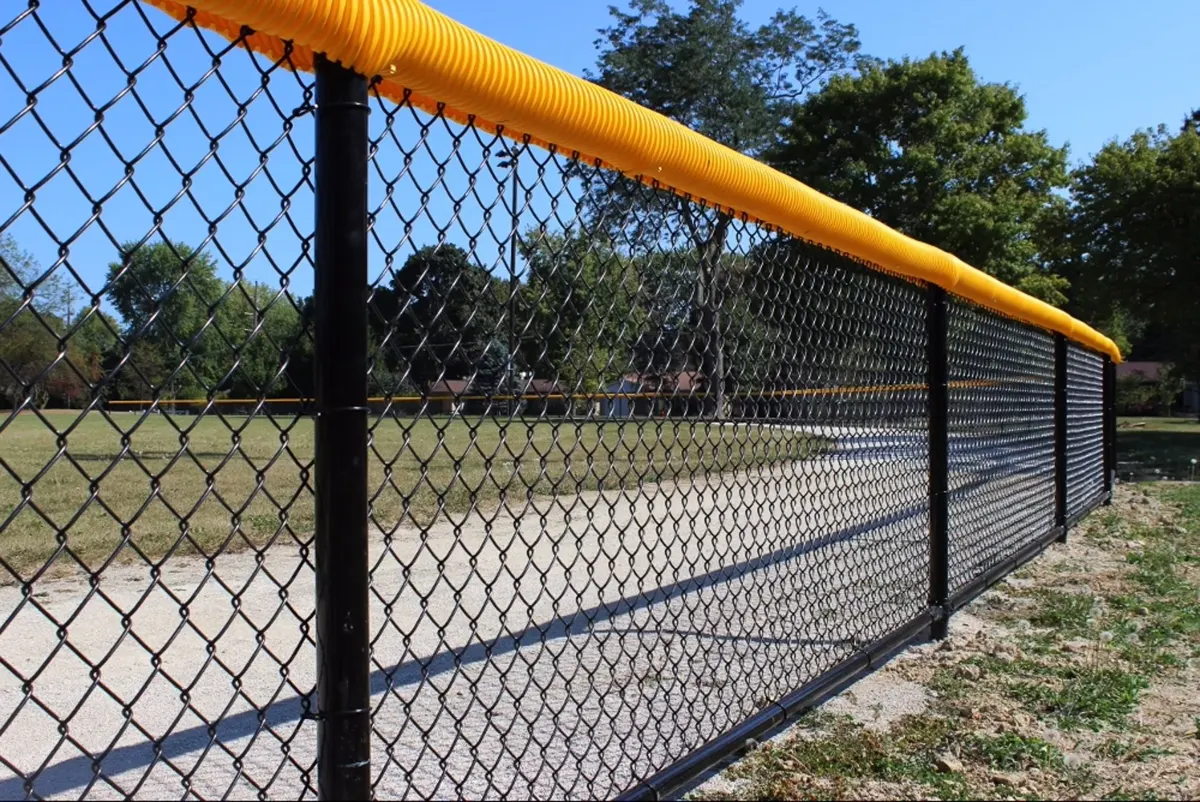
| Chain link | Openings no larger than 1 3/4 inches in the 2021 code. The CPSC’s guide says 1 1/4 inches square unless slats reduce the openings | [1, 2] |
| Gate | Opens outward, away from the pool, closes on its own, latches on its own, and can take a lock | [1, 2] |
| Latch | The release sits at least 54 inches above the ground. If it is lower, it goes on the pool side, at least 3 inches below the top of the gate, with no opening over 1/2 inch within 18 inches of it | [1, 2] |
Where the house forms one side of the barrier, the code asks for one of several protections on the doors and low windows that open to the pool: an alarm, a safety cover that meets ASTM F1346, or doors that close and latch on their own [1].
How is a pool fence specified and permitted when we build one?
We build pool fence in aluminum. The four-foot panels meet the 48-inch line, with taller ones where a town asks for more, and the gate hardware, picket spacing, and rail placement are picked to suit the code at your address. A specialist checks which rules apply before anything is ordered, and our permitting department handles the permit when we install. The specifics are on our aluminum pool fencing page.
When should you check with your building department?
Check before the pool is set up, before you build a deck or stairs to it, and before you change a fence that already serves as the barrier. Ohio’s statewide residential code will not answer the question. Its swimming pool section is marked deleted [7], so the rule you follow is your city’s or township’s.
Two cities show the spread. Columbus requires a building permit for any pool that can hold more than 24 inches of water and a barrier at least 48 inches high, and it exempts an above-ground pool at least 48 inches tall that has a removable ladder or a barrier around the ladder [8]. Westerville requires every pool to be enclosed to an older model code, Appendix G of the 2006 International Residential Code, and keeps a pool and its deck at least ten feet from the side and rear property lines [9].
For fences in general, our guide to fence permit rules in Ohio cities covers who needs one. Before anyone digs post holes near a pool, read what 811 marks and what it leaves to the homeowner, because pool lines are private lines that 811 does not mark. The rest of our fence guides cover heights and materials.
Questions about above-ground pool fences
Does an inflatable or soft-sided pool need a fence?
It can. The current model code treats storable pools with flexible walls as on-ground pools, which have to meet its barrier section [1], and older editions apply to any pool deeper than 24 inches [6]. Columbus uses that 24-inch line for its permit [8].
Can a pool safety cover take the place of a fence?
Only a powered one, and only where your town has adopted the exception. The model code waives the barrier for a swimming pool with a powered safety cover that complies with ASTM F1346, the standard for pool and spa safety covers [1, 10]. Columbus applies the same exemption [8].
Is a chain link fence allowed around a pool?
Yes, with small mesh. The 2021 model code limits chain link openings to 1 3/4 inches [1], and the CPSC’s guide recommends mesh no larger than 1 1/4 inches square unless slats fastened at the top or bottom reduce the openings [2]. Your building department can tell you which figure it enforces.
How far does a pool fence need to stand from things a child could climb?
The model code gives one distance: pumps, filters, and heaters outside the barrier sit at least 36 inches from it, and the 48-inch height has to hold for 3 feet out from the fence [1]. For everything else, the CPSC’s guide says to place the barrier so that permanent structures and equipment cannot be used to climb it, without naming a distance [2].
Sources
- International Swimming Pool and Spa Code, 2021 edition, Section 305, Barrier Requirements. International Code Council.
- Safety Barrier Guidelines for Residential Pools, Publication 362. U.S. Consumer Product Safety Commission.
- Drowning Facts. Centers for Disease Control and Prevention.
- Pool or Spa Submersion: Estimated Nonfatal Drowning Injuries and Reported Drownings, 2026 Report. U.S. Consumer Product Safety Commission.
- Preventing Drowning. Centers for Disease Control and Prevention.
- International Residential Code, 2012 edition, Appendix G, Swimming Pools, Spas and Hot Tubs. International Code Council.
- Ohio Administrative Code 4101:8-3-01, Building Planning (Residential Code of Ohio). Ohio Board of Building Standards.
- Swimming Pools information sheet, April 2026. City of Columbus Building and Zoning Services.
- Codified Ordinances of Westerville, Chapter 1174, Swimming Pools. City of Westerville.
- ASTM F1346-23, Standard Performance Specification for Safety Covers and Labeling Requirements for All Covers for Swimming Pools, Spas and Hot Tubs. ASTM International.
City fence rules change and vary by lot. This guide is general information, not a ruling on your property. The Mae Fence office nearest you knows the current code for your town and handles the permit when your town needs one. Find your office