How to Add Wire Mesh to a Split Rail Fence
By Mae Fence Company
Wire mesh goes on a wood split rail fence in four moves: fasten it to the side the animal is on, fix one end at a post, pull it tight, and staple it along the rails. Choose the opening for the animal, because mesh that holds a large dog will not stop a raccoon reaching for a chicken, and close the bottom edge against digging [1, 5, 8].
What are the steps, from bare rails to finished mesh?
The published instructions for this job are written for farm and horse fence on wood posts. The same order of work applies to a rail fence in a yard.
| Step | What you do | What to watch for |
|---|---|---|
| 1. Check the wood | Walk the line and replace any rail or post that is soft, split, or loose | Staples pulling out of the wood is one of the most common fence failures, and soft wood makes it worse [1] |
| 2. Choose the mesh | Pick welded or woven wire, then the opening, the gauge, and the coating for your animal (next section) | Welded mesh is rigid and suits level ground and short runs. Woven wire follows uneven ground [3] |
| 3. Pick the side | Put the mesh on the side of the fence nearest the animal | An animal that pushes on the fence then presses the wire against the wood, not off its fasteners [1, 2] |
| 4. Fix one end | Fasten the mesh at an end post before you pull anything | Work in sections, from one end or corner post to the next [1] |
| 5. Stretch, then staple | Pull the top and bottom at the same rate, check that the bottom wire is within two inches of the ground, then staple with galvanized staples | Stretch slowly and never with a truck or car. On woven wire, staples are driven close but not tight, so the wire can still move with heat and cold [1, 2] |
| 6. Close the bottom | Lay or bury a strip of mesh along the ground on the animal’s side | A footer bent out at a right angle stops digging at the fence line [8] |
Tension is what makes the fence hold. Mesh that sags between posts leaves a gap at the bottom and gives when an animal leans on it, which is why the instructions fix one end, pull, and only then fasten along the line [2].
Which mesh opening and gauge hold the animal you are keeping in?
The opening matters more than the strength of the wire. One manufacturer’s dog fence guide calls the size of the openings the most important thing to consider, and says dogs do not generally need overly strong fencing [4].
| Animal | Opening | Height and gauge | Source |
|---|---|---|---|
| Large dogs | Larger openings work and cost less. Welded mesh for dog runs is sold up to 2 by 4 inches | 42 to 60 inches tall, depending on the breed and its temperament. Welded mesh runs from light 17 gauge to 12 1/2 gauge | [3, 4] |
| Small dogs and puppies | Smaller openings, above all along the bottom of the fence | The same 42 to 60 inch range, set by temperament more than size | [4] |
| Chickens, with raccoons or weasels about | Smaller than 1 inch, so a predator cannot reach through. Flocks behind 1 by 2 inch mesh lose fewer birds than flocks behind 2 by 3 inch. A least weasel fits through a 1/4 inch hole | Coyotes and bobcats clear a 4 foot fence, so height alone does not protect a flock | [5, 6, 7] |
Welded and woven wire fail differently. Welded mesh is a grid fixed at every crossing, so it stays flat but cannot flex over a rise. Woven wire is held by knots that let it follow a slope and take pressure without a weld to break [3].
The coating decides how long the wire lasts. Galvanized wire is sold by zinc class: Class 1 is the lightest coating and Class 3 the heaviest, and one extension guide credits Class 3 with 5 to 10 more years of life in a humid climate [1]. On mesh that was galvanized before it was welded, the heat burns the zinc off at each weld and leaves bare steel there, which is where rust starts [12]. A vinyl coat bonded over galvanized wire puts a second layer between the steel and the weather [12].
What does a good mesh job look like, and what means it needs redoing?
A sound job is easy to read from the yard. The mesh is taut from post to post, it lies flat against the rails, the bottom edge follows the ground in one line, and every staple is seated.
These are the signs it needs redoing:
- Sag between posts. The mesh was fastened before it was pulled tight (step 5).
- A gap under the bottom wire. Anything more than about two inches invites a dog to push under (step 5) [2].
- Staples backing out. The wood is soft or split, or the staples are not galvanized and have rusted thin (steps 1 and 5) [1].
- Rust at the crossings. It usually shows first at the welds of mesh that was galvanized before welding [12].
- Fresh digging at the fence line. The bottom was never closed off (step 6).
What mesh do we put on a wood rail fence?
We use black vinyl-coated, galvanized mesh with 2 by 4 inch openings in 14 gauge wire, fastened to the rails with 3/8 inch staples. It goes on wood split rail and wood ranch rail only. Vinyl rail fences cannot take mesh. Our split rail is two or three rough-split rails let into notched posts set 10 feet on center.
Set against the table above, a 2 by 4 inch opening is the size sold for dog runs, and 14 gauge sits inside the range of welded mesh gauges, heavier than the light 17 gauge end [3]. For poultry it is a different answer. A 2 by 4 inch opening is wider than the under 1 inch that extension services recommend where raccoons and weasels are a threat, so on its own it keeps a flock in without keeping a reaching predator out [5, 7].
Split rail mesh questions
Does wire mesh need to go below ground to stop a dog from digging out?
It needs to turn outward more than it needs to go deep. The humane-society method is an L-shaped footer: mesh bent out at a right angle for a foot or more, ideally buried about a foot down. Where roots or rock make digging impossible, the footer can lie on the surface, pinned with landscape staples, until grass grows through it [8].
Will galvanized mesh and staples rust where they touch treated wood?
The fasteners are the weak point. The copper in current wood preservatives is more corrosive to metal than the older treatments were, so fastener makers and the galvanizing industry recommend hot-dip galvanized or stainless steel fasteners in treated lumber. Electroplated zinc does not count as hot-dip galvanized [10, 11].
Can a dog climb a rail fence once mesh is on it?
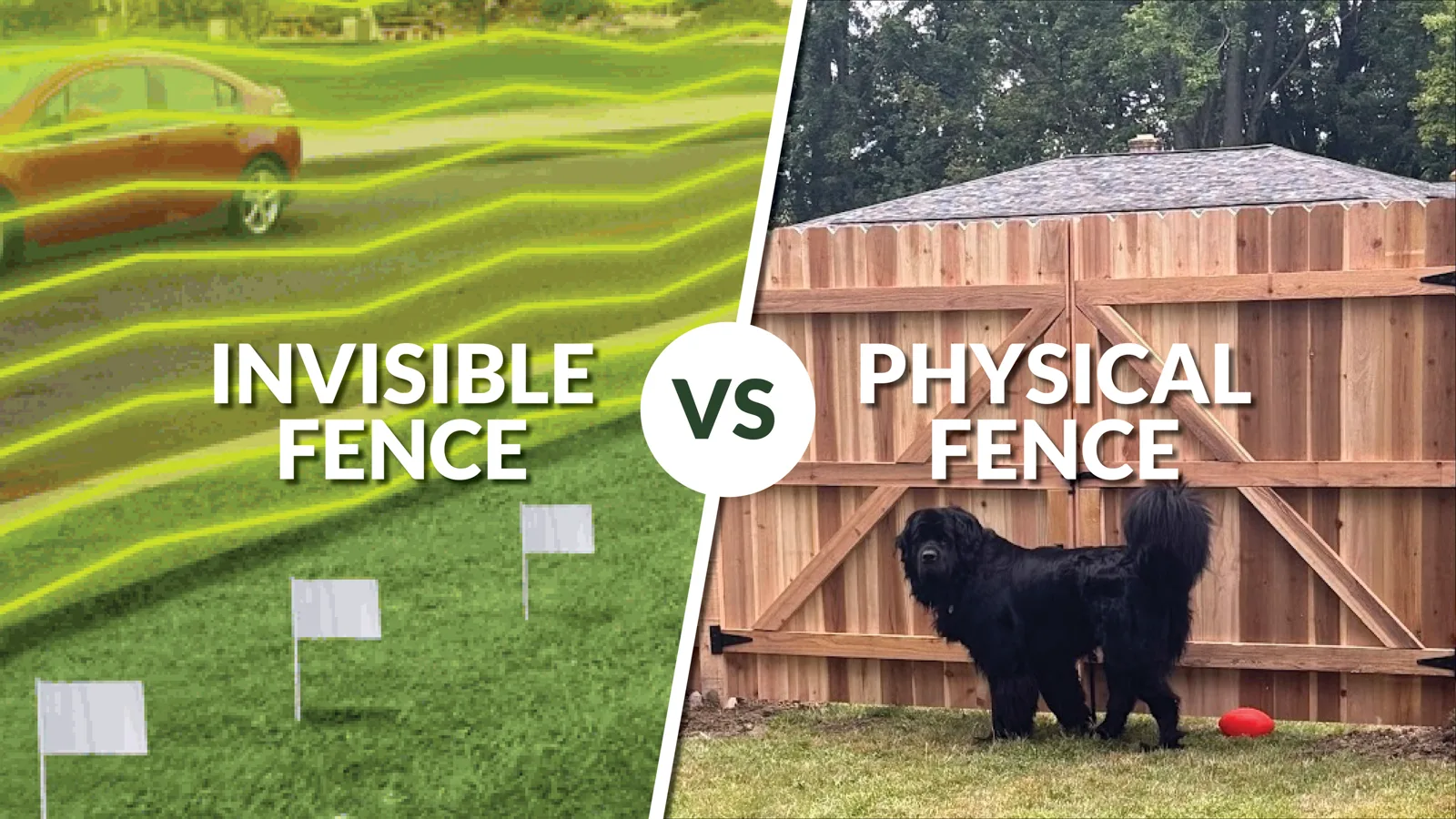
A determined climber can go over most fences, so the fix is above the mesh, not in it. Humane World for Animals recommends an extension along the top that tilts inward at about 45 degrees, and keeping tables, chairs, and dog houses away from the fence so they cannot be used as a springboard [9]. If your dog is an escape artist, our comparison of invisible fences and physical fences for dogs covers the other ways dogs get out.
How should the staples be driven?
With the grain, and not hammered flat. The University of Georgia’s fence guide says to set each staple parallel to the grain of the wood and then turn it slightly, so the two legs spread as they go in and grip. On woven wire it should hold the wire close without pinching it [1].
Sources
- Fences for the Farm (Circular 774). University of Georgia Cooperative Extension.
- Installation Guide. Red Brand (Keystone Steel & Wire).
- Welded Wire Fence. Red Brand (Keystone Steel & Wire).
- Dog Fence Requirements. Bekaert Fencing.
- What are the best ways to protect my chickens from predators? University of New Hampshire Extension.
- Chickens and Predators. Colorado State University Extension.
- Predator Management for Small and Backyard Poultry Flocks. Poultry Extension, Cooperative Extension System.
- How to stop animals from digging or burrowing under fences. Humane World for Animals.
- How to Keep Dogs From Running Away. Humane World for Animals.
- FAQ: Preservative-Treated Wood. Simpson Strong-Tie.
- Recommended Connectors with Pressure-Treated Wood. American Galvanizers Association.
- Galvanized After Welding. Riverdale Mills.
See the split rail and ranch rail styles we build, with mesh, on our rail fence page, or browse the rest of our fence guides.